Forty covers and a noisy Saturday night are no place to say something that matters. Whether it is a milestone birthday, a retirement send-off, a rehearsal dinner, or a deal-closing corporate meal, the setting shapes the memory just as much as the food does. Private dining rooms have moved from an occasional luxury to the obvious first choice for anyone planning an occasion that deserves more than a corner booth.
And planners are paying attention. This piece breaks down what actually separates a great private dining experience from a disappointing one, how to read a venue before you book, and the specific details that turn a nice dinner into something guests talk about for years.
The Shift Toward Experience-First Dining
Something changed in the American dining market around 2023 and has only accelerated since. People stopped treating restaurants purely as a place to eat and started treating them as the actual event.
Many restaurant customers, including 64% of full-service customers and 47% of limited-service customers, say their dining experience is more important than the price of the meal, according to the National Restaurant Association’s 2025 State of the Restaurant Industry report published on restaurant.org. That is not a niche sentiment. That is the majority of diners at full-service restaurants actively choosing atmosphere and service over cost savings.
Private dining is the logical endpoint of that preference. You are not just buying a table. You are buying an environment you control, a timeline that bends to your group, and staff whose only job that evening is your table. For a birthday dinner with twelve people who haven’t been in the same room in years, that difference is everything.
What a Private Room Actually Gives You That a Regular Table Doesn’t
The obvious answer is privacy. But privacy is only one of five real advantages, and it isn’t even the most important one for most groups.
Sound control. A dedicated room means your conversation is your conversation. No competing with the table next to yours, no projecting across a noisy dining room, no one overhearing the toast.
Timing that belongs to you. A restaurant running a busy floor moves at its own pace. A private room moves at yours. Speeches happen when you’re ready. The next course waits until the table is ready for it. That sounds small until you’ve been rushed through a birthday dessert because the kitchen needed the table back.
Bespoke menus. Most quality private dining venues will build a custom menu around your event, sometimes anchored around dietary needs, sometimes around a particular theme or cuisine style, occasionally around a specific wine pairing. You get to have that conversation before the night, not apologetically at the table.
Dedicated service staff. Your server isn’t splitting attention across four tables. This alone changes the tenor of the evening in ways that are hard to fully describe until you’ve experienced it.
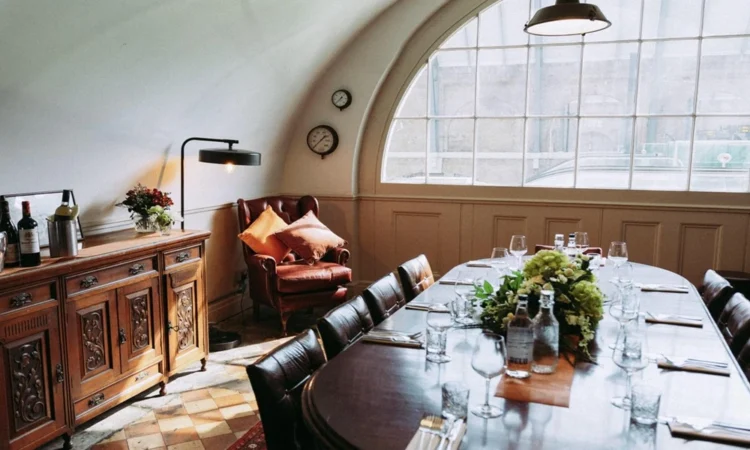
Visual identity. The room is yours to dress. Florals, signage, a custom menu card, a specific table arrangement for the group size. These are the details that show up in photographs and in people’s memories.
The 3-Question Venue Filter
Not every venue that advertises private dining delivers on the premise. Before you commit a deposit, run any venue through these three questions. They separate genuinely private experiences from rooms that are private in name only.
- Is the room fully enclosed, or is it a partitioned area? Partitions muffle sound poorly and offer no visual privacy. A true private dining experience means four walls and a door. Any venue that hedges on this answer is telling you something.
- Does the kitchen build a custom menu for private events, or does your group order off the standard menu? Standard menus are fine for a casual group dinner. For a milestone occasion, a custom menu is the difference between a special evening and a slightly more expensive regular one.
- Is a dedicated server assigned to your room for the duration of the event, or does staff rotate? Rotating staff means inconsistent pacing and guests who have to re-explain their needs multiple times across the evening. Dedicated service means continuity and genuine attentiveness.
Any venue that gives you strong, confident answers to all three is worth a serious look. A venue that hedges on two out of three is worth a polite pass.
Matching Room Size to the Moment
One mistake planners make is choosing a private dining room that fits the guest count but not the occasion. A room sized for 228 guests feels hollow with 20. A room built for 12 feels claustrophobic with 30. The best venues offer a range of spaces, from intimate eight-to-twelve-person rooms for quiet milestone dinners to larger halls that work for corporate receptions or multi-family celebrations.
Think in terms of energy density, not just square footage. You want the room to feel full and warm, not cavernous. A group of 25 in a room designed for 30 has good energy. That same group in a room built for 80 will spend the evening feeling like they’ve shown up to the wrong party.
For corporate planners specifically, room flexibility matters in a different way. A company sending clients out to dinner for relationship-building needs an intimate setting where conversation flows easily. A room that seats 50 works for that only if it can be configured in a way that doesn’t feel like a boardroom.
Why the Venue’s Core Cuisine Still Matters
Private dining is an elevated version of a restaurant’s regular offering, not a separate product. Which means the quality of the kitchen’s everyday cooking sets the ceiling for what your private event can be. A steakhouse with a legitimate commitment to sourcing and preparation brings those standards into the private room. A venue that cuts corners on its public-facing menu will cut them behind the closed door, too.
This is why choosing a venue you’d want to eat at on an ordinary Tuesday is better advice than choosing one with the fanciest private event brochure. A 2024 national survey by US Foods found that 55% of consumers said they prefer dining out at restaurants rather than ordering takeout or delivery, a sharp increase from the 43% who favored dining out in 2023, according to data reported by Auguste Escoffier School of Culinary Arts. That shift toward in-person dining is not about convenience. It is about atmosphere and genuine hospitality, which are exactly what private dining amplifies.
Groups looking for that combination in Colorado Springs have found a strong option in elegant private dining at Roth’s Sea & Steak, where nine distinct rooms ranging from an intimate 12-seat setting to a rooftop space accommodating over 150 guests are paired with bespoke menus and the kind of attentive service that justifies the occasion.
A Practical Checklist Before You Book
Once you’ve shortlisted venues, this is the sequence that prevents surprises on the night:
- Confirm the room is fully enclosed with a closing door
- Ask for a written proposal that specifies the custom menu process and who your day-of contact is
- Request a room walk-through before signing anything, even if it’s a short one
- Clarify AV capabilities if you’re planning a presentation, a slideshow, or a live microphone moment
- Get the deposit and cancellation policy in writing, not just verbal confirmation
- Confirm the event start and end time with buffer time built in on both ends
- Ask whether décor setups by a florist or outside vendor are permitted and what the logistics look like
None of these are difficult asks. A venue with real private dining infrastructure handles them without blinking. If a venue treats these questions as unusual, that’s information worth having before you’ve signed anything.
The Real Measure of a Great Private Event
You’ll know a private dining experience hit the mark when the guests don’t want to leave. That sounds like a platitude, but it is actually a precise outcome: it means the pacing was right, the food was memorable, the service was invisible in the best sense, and the room felt like it belonged to the group for the evening.
Planning achieves that. The venue choice achieves that. The questions you ask before you book achieve that. What doesn’t achieve it is waiting until the night itself and hoping for the best. Private dining rooms do their best work when someone spent the right amount of time choosing them.