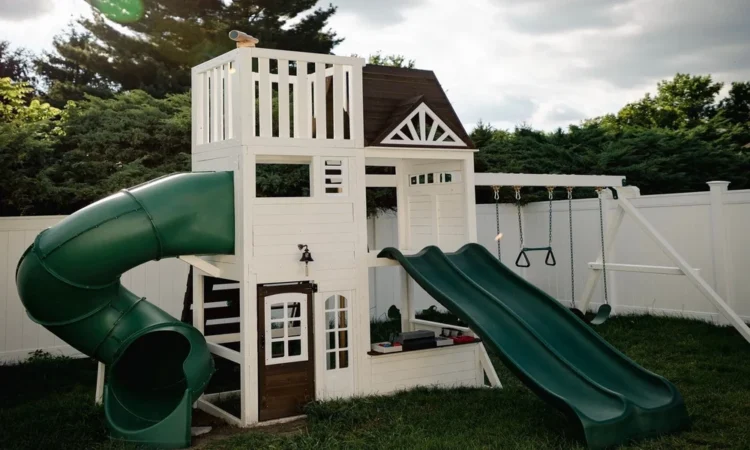
Most parents get this decision backwards. They fall in love with a playset photo, buy it, and then realize the deck is too tall for their three-year-old, the swing beam clips the fence, or the whole structure gets outgrown inside eighteen months. The right call is to start with three hard numbers: your kids’ ages, your yard’s usable square footage, and the deck height that fits both. Everything else, including the fort style, the slide length, and the accessories, flows from those three.
This guide walks you through exactly that process, from measuring your space to picking the features that will actually get used five years from now.
Why Getting Kids Outside Is Worth the Investment
Screen time is genuinely competing for your kids’ afternoons. According to a CDC data brief published in October 2024, 50.4% of teenagers ages 12 to 17 reported using screens at least four hours a day, which the CDC classifies as “high screen use.” The trend starts well before the teen years, which is exactly when a compelling backyard setup can shift the default.
The research on what outdoor play actually does for kids is solid. A study cited by UNICEF found that children who spent at least two hours a day outside had 27% more moderate-to-vigorous physical activity than children who did not. A swing set does not guarantee two hours outside, but it makes that two hours a lot more likely when your kids can walk out the back door to something genuinely engaging.
When children play outside, they use their imaginations, learn about nature, build small and large muscles, and develop social skills simultaneously. That is a long list of returns on a one-time purchase.
The AGED Framework: Matching the Set to Your Stage
The single most useful thing you can do before shopping is apply what I call the AGED Framework: Age range of your kids, Growth window you want to cover, Equipment height that fits, and Deck features that match their development. Run those four filters and the field narrows fast.
Here is how age maps to deck height and feature priorities across a typical family buying window:
| Child Age Range | Recommended Deck Height | Key Features to Prioritize | Features to Skip (for now) |
|---|---|---|---|
| 2 to 4 years | Under 4 feet | Bucket swings, gentle slide, low rock wall | Rope ladders, tall tube slides |
| 4 to 7 years | 4 to 5 feet | Belt swings, wave slide, sandbox base | Extremely steep climbing walls |
| 7 to 12 years | 5 to 6 feet | Rock wall, rope ladder, trapeze bar, 360 tire swing | Toddler-only accessories |
| Mixed ages (3+ kids) | 5 feet or taller | Multiple swing positions, castle-style fort, dual slides | Single-function towers |
One honest take: if your youngest is two and your oldest is eight, buy for the eight-year-old’s ceiling, not the two-year-old’s floor. You can add a bucket swing seat to any set, but you cannot make a small deck feel bigger once the kids hit a growth spurt.
Measuring Your Yard Before You Buy Anything
The footprint number that surprises most families is not the playset itself but the required fall zone around it. The Consumer Product Safety Commission recommends a fall zone of at least 6 feet in every direction around the perimeter of any residential playset. That means a 12-foot-wide structure needs a minimum 24-foot-wide clear area, and that is before you account for the swing arc.
Swing arcs extend in front of and behind the beam, not to the sides, so map them separately. A general rule: the swing beam height, doubled, gives you a reasonable front-to-back arc clearance number to plan against. Add 6 feet, per CPSC guidance, and you have your minimum zone.
For a practical scenario, picture the Nguyen family: a 40-by-50-foot backyard in a midwest suburb with a 10-foot setback from the fence on two sides and a garden bed taking up the rear corner. Their usable play rectangle works out to roughly 28 by 36 feet. That rules out any footprint over about 16 by 24 feet once the fall zone is included, which points them squarely at a 5-foot deck clubhouse fort rather than the sprawling castle setup they originally wanted. The clubhouse’s box-style base packs more play value into a smaller footprint, solves the space constraint, and still gives their kids room to grow into it.
Measure twice. The disappointment of a set that does not fit the yard is much worse than a five-minute tape measure session upfront.
Fort Style: Castle vs. Clubhouse, Settled
Most families agonize over fort style longer than they should. The decision actually comes down to two variables: how many kids will use it at once, and how much open-air versus enclosed play your kids prefer.
Castle-style forts work best for multiple children and active climbers. They offer more attachment points for swings, more climbing options on all sides, and better airflow on summer afternoons. Clubhouse-style forts give kids a more enclosed, treehouse feel and pack a lot of activity into a smaller base. The base of a clubhouse is designed to function as a sandbox, a lemonade stand, a playhouse, or even a small general store insert, which means imaginative play gets a dedicated space.
If you have three or more kids under ten, go castle. If you have one or two kids who gravitate toward fort-building and pretend play, go clubhouse. Both styles accommodate the full range of backyard playground equipment for families, from rock walls and rope ladders to 360-degree tire swings, so neither limits your feature options.
A Safety Checklist Before Installation Day
Playset safety on residential equipment comes down to four things most parents underestimate.
The U.S. Consumer Product Safety Commission is a government agency that addresses risks of injury, develops safety standards, and conducts research, and it has published a Handbook for Public Playground Safety that contains widely referenced safety guidelines for residential equipment as well. Read the residential version, CPSC publication 324, before your set goes in the ground. It takes about twenty minutes.
Beyond the handbook, work through these four checkpoints:
- Surfacing: Wood chips, shredded rubber mulch, or engineered wood fiber all work. Concrete, asphalt, and bare dirt do not absorb falls. Depth matters as much as material type.
- Fall zone clearance: 6 feet on all sides, measured from the outermost edge of the structure, not the post footprint.
- Hardware inspection: Before first use and every spring after, check all bolts, S-hooks, and swing chains for wear, rust, and sharp edges.
- Entrapment openings: Any opening on the structure should either be too small for a child’s head to enter or large enough for the whole body to pass through freely. Nothing in between.
A well-built wooden set from a reputable manufacturer will already meet or exceed ASTM F1148, the Standard Consumer Safety Performance Specification for Home Playground Equipment. Ask for that documentation before you buy.
The Five Questions to Answer Before You Order
Pull these together into a quick pre-purchase checklist and you will not end up returning anything:
- What are the ages of every child who will use this set regularly?
- What deck height fits the oldest child’s capabilities without overwhelming the youngest?
- What is your usable yard rectangle after subtracting setbacks and landscaping?
- Does the fall zone fit inside that rectangle with 6 feet of clearance on all sides?
- Does the fort style match how your specific kids actually play, not how you imagine they will?
Answer those five honestly and you narrow the field from dozens of configurations to two or three real contenders. That is a much better place to make a final call.
Your backyard is one of the few spaces where you fully control what your kids do with their free time. The playset you pick either becomes the place they spend their afternoons for the next eight years, or it becomes expensive yard furniture. The difference is almost always that decision made upfront about deck height, yard fit, and age range. Get those right, and the rest is just fun.